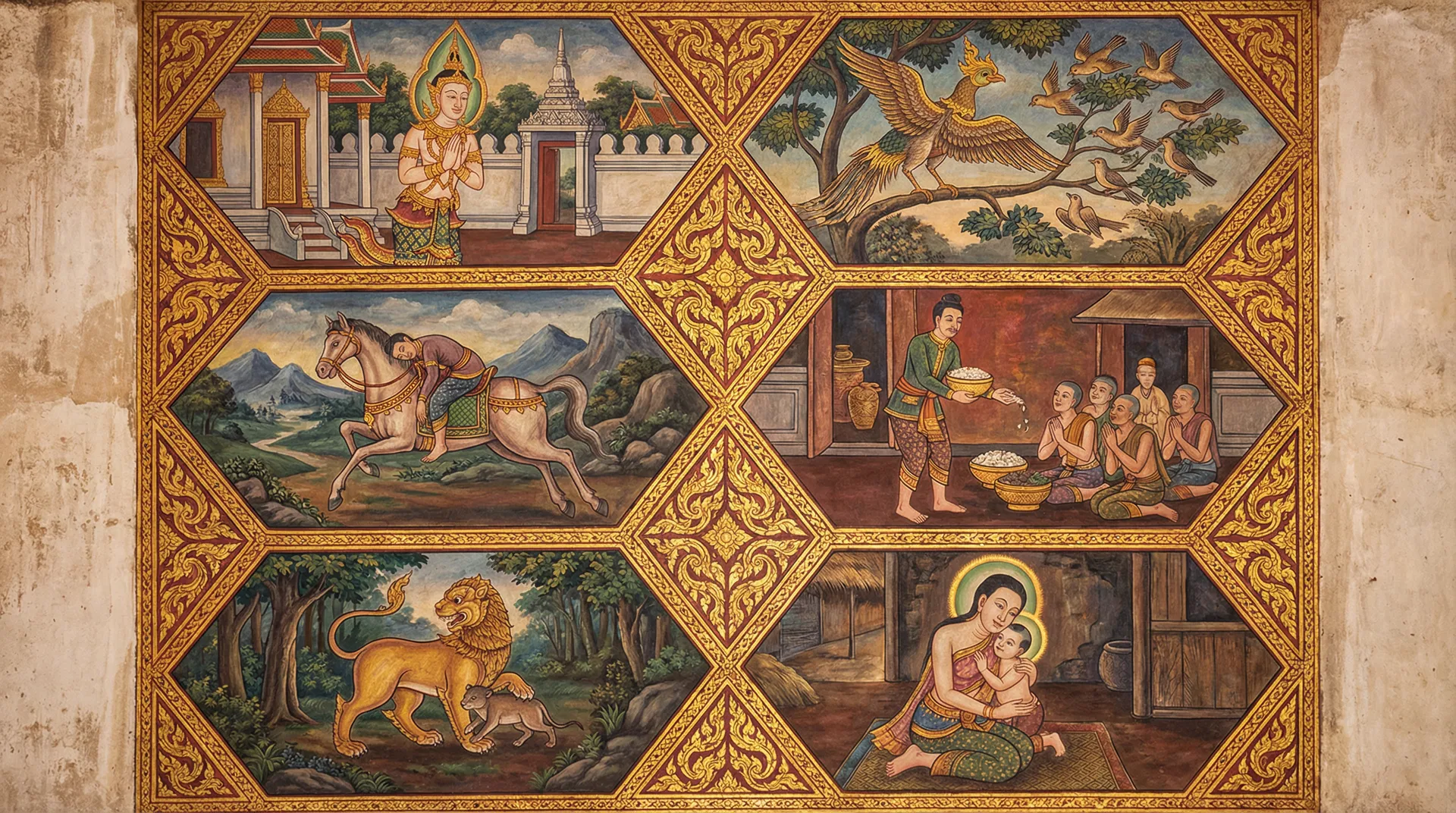
Mūkapacca Jātaka
Mūkapacca Jātaka
In the ancient city of Mithila, nestled within the prosperous kingdom of Videha, lived a king renowned for his wisdom and justice. His name was King Janaka, a ruler whose reign was a beacon of prosperity and peace. Yet, even in this idyllic land, a shadow of discontent began to stir amongst a group of merchants. These were not ordinary traders; they were ambitious, driven by an insatiable hunger for wealth, and often, by questionable means. They congregated in the bustling marketplace, their voices a cacophony of boasts and envious whispers, their eyes gleaming with the prospect of ever-greater riches.
Amongst them was a particularly shrewd merchant, known for his cunning and his ability to manipulate situations to his advantage. He was a master of deception, his words flowing like honey, masking a heart of stone. One day, this merchant, let's call him Dhanapāla, approached the king with a proposition that seemed, on the surface, to benefit the entire kingdom. He declared, "Your Majesty, I have discovered a hidden treasure, a vast trove of precious gems and gold, buried deep within the treacherous peaks of the Himalayas. If you grant me the resources – ships, men, and supplies – I shall embark on a perilous journey and return with riches that will fill your coffers and bring unparalleled prosperity to Videha."
King Janaka, a king who valued truth and righteousness above all else, was intrigued. He summoned his most trusted advisors, men of great learning and foresight. They debated the matter, their brows furrowed in contemplation. One wise elder, with eyes that held the wisdom of ages, spoke with a gentle but firm voice, "Your Majesty, the Himalayas are a place of mystery and danger. While the promise of wealth is tempting, we must be wary of deception. Dhanapāla is known for his silver tongue, but his heart is often veiled. Let us consider the true nature of this proposition."
However, the allure of immense wealth was too strong for many. The other merchants, eager to share in the promised bounty, egged Dhanapāla on. "Indeed, Your Majesty!" they chimed in, their voices eager. "Dhanapāla is a man of great courage and vision. We should support his endeavor." swayed by the collective enthusiasm and the shimmering prospect of unearned riches, King Janaka, though with a sliver of doubt, agreed to fund Dhanapāla's expedition. He provided him with a fleet of ships, laden with provisions, and a contingent of brave soldiers to protect him and his crew.
Dhanapāla, basking in the king's favor, set sail. He was not heading towards the Himalayas, however. His true destination was a remote, uninhabited island far across the sea, a place he had scouted years before. His plan was audacious: to hoard the king's provisions, sell them for a handsome profit on other lands, and then return with tales of a fruitless search and a fabricated story of treacherous encounters. He sailed for many days, the sea winds filling his sails, a smug smile playing on his lips.
Meanwhile, back in Mithila, King Janaka patiently awaited Dhanapāla's return. Weeks turned into months, and the anticipation began to wane, replaced by a gnawing unease. The wise elder, seeing the king's disquiet, spoke again, "Your Majesty, perhaps it is time to send out a search party. Not to the Himalayas, but to the usual trading routes, to see if any news of Dhanapāla has surfaced."
King Janaka, his heart heavy with foreboding, dispatched a smaller, swifter vessel. This ship, manned by experienced sailors, was ordered to follow Dhanapāla's general course, but to do so discreetly. They sailed for days, their eyes scanning the horizon. Then, in the distance, they spotted it – a ship, heavily laden, anchored off the coast of a small, desolate island. As they drew closer, they recognized Dhanapāla's vessel. And there, on the shore, was Dhanapāla himself, overseeing the unloading of goods onto another ship, one belonging to foreign traders!
The king's men, their hearts pounding with righteous anger, revealed themselves. Dhanapāla, caught red-handed, was stunned. He stammered, trying to concoct a story, but the evidence was irrefutable. The foreign traders, seeing the king's banner, quickly fled, leaving Dhanapāla to face the consequences of his treachery. He was brought back to Mithila in chains, his deceit exposed for all to see.
King Janaka, though deeply disappointed, did not succumb to anger. He summoned Dhanapāla before the royal court. The merchant, his face pale and his spirit broken, confessed his crime. He had never intended to seek treasure in the Himalayas. His plan was to betray the king, enrich himself, and escape the kingdom. He had sold the king's provisions to foreign merchants, amassing a personal fortune.
The king, after hearing the confession, addressed Dhanapāla and the assembled crowd. "You have brought shame upon yourself and dishonor to our kingdom," he declared, his voice resonating with a profound sadness. "Your greed has blinded you to the virtues of honesty and loyalty. You sought riches through deceit, but true wealth lies not in gold and gems, but in integrity and a good name."
Instead of imposing a harsh punishment, King Janaka, in his infinite wisdom, chose a different path. He decreed that Dhanapāla would forfeit all his ill-gotten gains, which would be used to support the kingdom's welfare. Furthermore, Dhanapāla was stripped of his merchant status and tasked with performing arduous, menial labor for the rest of his days, tending to the kingdom's stables and sanitation. His punishment was not to inflict suffering, but to teach him the value of humility, hard work, and the dignity of honest labor. He was to live a life of service, a constant reminder of the consequences of his betrayal.
The other merchants, witnessing Dhanapāla's downfall, were filled with remorse and fear. They understood the gravity of their complicity and the king's unwavering commitment to justice. From that day forward, the marketplace in Mithila was transformed. Merchants conducted their business with renewed honesty and integrity, their dealings guided by truth and fairness. The story of Dhanapāla became a cautionary tale, whispered among traders for generations, a testament to the fact that deceit, no matter how cunningly planned, will always be exposed, and true prosperity can only be built upon a foundation of virtue.
The king, observing the renewed spirit of honesty in his kingdom, felt a deep sense of peace. He knew that his people, having witnessed the unmasking of deceit and the triumph of justice, would continue to live lives of integrity, bringing lasting prosperity and renown to the kingdom of Videha. The Mūkapacca Jātaka thus serves as a timeless reminder that a mute mouth, unable to speak falsehoods, is a blessing, but a speaking mouth that chooses truth is a far greater virtue.
— In-Article Ad —
💡Moral of the Story
Deceit and greed ultimately lead to downfall, while honesty and integrity are the true foundations of lasting prosperity.
Perfection: Wisdom (Paññā)
— Ad Space (728x90) —
More Jataka Tales You May Enjoy
 492Pakiṇṇakanipāta
The Tale of the Grateful Swan
The Tale of the Grateful Swan Once upon a time, in a kingdom blessed with verdant forests and sparkl...
💡 Kindness shown to any living being, no matter how small or seemingly insignificant, is never wasted and can return to us in unexpected and miraculous ways. Gratitude is a powerful force for healing and good.
 22Ekanipāta
The Bodhisatta as a Skilled Physician
The Bodhisatta as a Skilled PhysicianIn the ancient city of Varanasi, renowned for its spiritual lea...
💡 True skill and compassion, combined with determination, can overcome formidable obstacles and bring about healing.
 279Tikanipāta
Assaka Jataka
The Tale of the Noble Prince and the Impatient Camel In a kingdom renowned for its lush landscapes a...
💡 Impatience leads to folly and suffering. True strength lies in patience, understanding the limits of oneself and others, and respecting the journey, not just the destination.
 188Dukanipāta
Kacchapa Jataka
The Tale of the Steadfast TortoiseIn the heart of a vast, sun-drenched jungle, where ancient trees r...
💡 Steadfastness, patience, and unwavering determination are virtues that can overcome immense challenges and lead to salvation.
8EkanipātaThe Wise King of Birds
The Wise King of BirdsPerched atop the highest peak of the Himalayas, where the air was thin and cry...
💡 True wisdom lies in selfless compassion, and the greatest sacrifices bring about miraculous salvation.
15EkanipātaThe Bodhisatta as a Scholar
The Bodhisatta as a ScholarIn the hallowed halls of an ancient monastery, nestled amidst serene, rol...
💡 True wisdom is demonstrated through the compassionate application of knowledge for the well-being of others.
— Multiplex Ad —